
Minnesota EV fees remain unchanged in 2026
June 17, 2026 | Carolyn Berninger | Policy
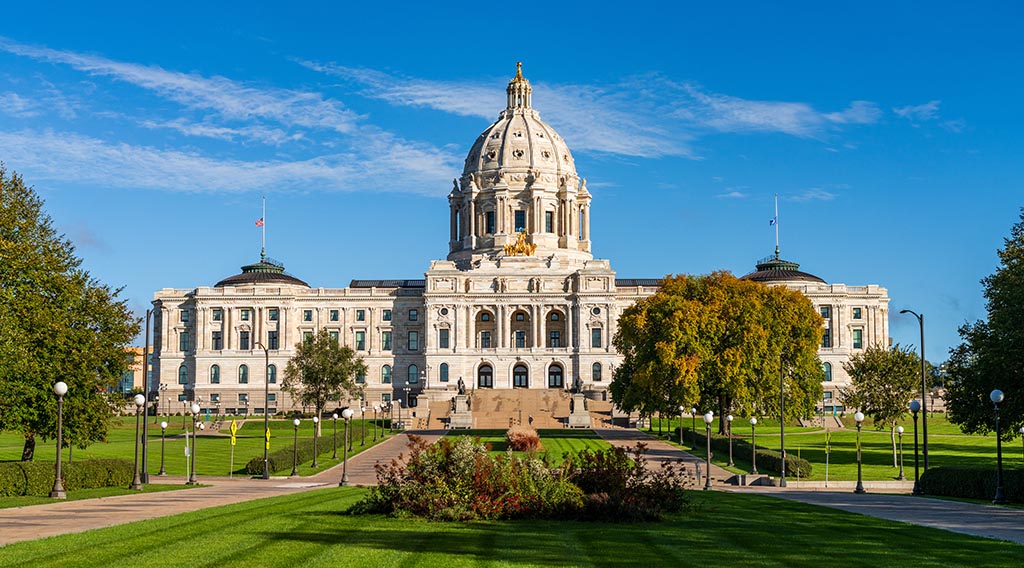
The Minnesota Legislature wrapped up its work for the 2026 legislative session on Sunday, May 17. How the state handles electric vehicle (EV) fees was once again a hot topic for legislators and advocates with an interest in electrification. Legislators considered multiple bills that would impact how Minnesota EV drivers contribute to roadway funding, and EV advocates showed up to fight back against unfair taxes and fees. Ultimately, none of those proposals made it across the finish line, and EV fees remain unchanged. Drive Electric Minnesota is concerned that Minnesota’s EV fees are unfair, will increase barriers to electrification, and undermine the state’s electrification and climate goals. The coalition remains focused on advocating for a fairer solution in 2027 and beyond.
Building off the 2025 session
During the 2025 legislative session, Minnesota lawmakers significantly increased fees on EV drivers by passing legislation to raise the registration surcharge for EVs—which took effect in 2026—and created a new public charging tax that takes effect next summer.
These new taxes and fees were an effort to address Minnesota’s road funding revenue shortfall and to ensure EV drivers pay their “fair share” to use the state’s transportation system. However, Minnesota’s current fee structure results in many EV drivers paying disproportionately more for road funding than gas car drivers. In fact, according to Atlas Public Policy, Minnesota now has the highest “EV penalty”—which measures how much more an EV driver who relies on public charging pays in road user fees and taxes than a gas car driver pays in gas taxes—of any state. For more information about the outcomes of the 2025 legislation and its impacts on EV drivers, read our blog post on the topic.
Following the 2025 session, the state convened the Electricity as Vehicle Fuel Working Group to analyze EV charging infrastructure opportunities and barriers, develop policy and funding recommendations, and discuss equitable and comprehensive fuel assessment methods for electric vehicles. Drive Electric Minnesota participated in that working group to represent the interests of Minnesota EV drivers and work to lower barriers to electrification for everyone. The coalition believes EV drivers should pay their fair share to support Minnesota’s roads and bridges, but they should not be required to pay more than drivers of equivalent gas vehicles.
Drive Electric Minnesota made the following recommendations to the working group:
- Implement an optional mileage-based user fee as an alternative to the registration surcharge and public charging excise tax. Such a system could be designed to reflect actual road usage and reward vehicle efficiency. For drivers who do not wish to participate in a mileage-based program, the state could maintain an option to pay a reasonable flat registration surcharge.
- Eliminate the public electric vehicle charging excise tax to avoid delaying infrastructure deployment and double-taxing EV drivers who already pay a registration surcharge. Because most EV drivers primarily charge their vehicles at home, public charging taxes are ineffective at capturing usage and replacing lost gas tax revenue. Public charging taxes also create inequitable impacts by disproportionately impacting those without home charging, including many renters and residents of apartment complexes.
- Eliminate the state sales tax on electricity at public charging stations. This would prevent double taxation on electricity used as a vehicle fuel.
- Establish a state EV tax rebate or sales incentive. Rather than creating new EV penalties, Minnesota should support EV adoption through rebate programs and other financial incentives. This would lower barriers to electrification for Minnesotans and help the state meet its climate and electrification goals.
- Provide state support to build out Minnesota’s EV charging network. More investment is needed to bolster the state’s charging infrastructure network, reduce “range anxiety,” increase access to electricity as a transportation fuel, and accelerate transportation electrification throughout Minnesota.
Ultimately, just one of Drive Electric Minnesota’s recommendations—eliminating the sales tax on electricity at public charging stations—was formally adopted by the working group in its final report. Other recommendations received support but failed to secure a majority vote. However, we have continued to work with legislators and other advocates to make the case for smart EV tax policy, and the Legislature is not locked into the working group’s recommendations.
The conversation continues in 2026
Heading into 2026, Drive Electric Minnesota partners identified fair EV fees as a key priority. Throughout the legislative session, legislators considered multiple proposals to change how EV drivers contribute to road funding. State Senator Johnson Stewart (45, DFL) authored Senate File 4169, which would implement some of the suggestions that came out of the Electricity as Vehicle Fuel Working Group, including expanding the public charging tax to both level 2 and level 3 charging stations (which Drive Electric Minnesota opposes) and eliminating the sales tax on public charging stations (which Drive Electric Minnesota supports). That bill was heard in the Senate Transportation Committee and “laid over,” or set aside for future consideration.
In the House, State Representative Kraft (46A, DFL) introduced House File 3430, which would replace the MSRP-based EV surcharge with a $100 fixed fee and create an additional surcharge for vehicles above 5,000 pounds. Drive Electric Minnesota testified in support of that bill at a hearing in the House Transportation Committee, where that bill was also laid over. State Representative Elkins (50B, DFL) introduced House File 1140, which would create a mileage-based road usage charge for all-electric vehicles, but it did not receive a hearing this year. Drive Electric Minnesota supports the state exploring mileage-based fees.
Looking ahead to 2027
Despite some attention to the topic, Minnesota lawmakers did not adopt changes specific to EV fees in 2026. All drivers will see some relief under a temporary rollback of tab renewal fees, but the annual EV surcharge remains at its current level, and the public charging tax is slated to go into effect in summer 2027.
Drive Electric Minnesota remains concerned that unfair EV fees will increase barriers to electrification and undermine the state’s electrification and climate goals without meaningfully addressing structural funding challenges. And with the federal government advancing a $130 annual EV fee, the disproportionate impact of road taxes on those choosing to drive electric will be even higher. Leading up to the 2027 legislative session, we will work to increase support for fair EV policy that incentivizes—and does not penalize—electrification.
If you would like to get involved in Drive Electric Minnesota’s policy work at the Minnesota Capitol, join the coalition today!
Share this post


