
Drive Electric Minnesota opposes nearly tripling the state EV fee
May 7, 2025 | Carolyn Berninger | Policy
Minnesota drivers contribute to roadway funding through a few key sources: the motor vehicle sales tax paid at the time of purchasing a vehicle, tab fees paid annually to renew vehicle registration, and gas taxes paid each time they fill up at a gas station. Because electric vehicle (EV) drivers don’t use gasoline, Minnesota has implemented a $75 annual registration surcharge to ensure EV drivers are paying their fair share to use the state’s roads.
Despite multiple sources of ongoing revenue, Minnesota’s Highway User Tax Distribution Fund (HUTDF) is projected to fall short of what’s needed to sustainably manage the state’s transportation systems. This is due to multiple factors, including inflationary pressures that increase the cost of building and maintaining roads and technological improvements and shifting consumer preferences toward more fuel-efficient vehicles.
Minnesota legislators move to nearly triple the state’s EV fee, increasing barriers to electrification
In a bid to increase transportation funding, leaders at the Minnesota Legislature have proposed to nearly triple Minnesota’s annual EV fee from $75 to $200 and to introduce new fees on plug-in hybrid vehicles and electric motorcycles. This would disproportionately burden EV drivers by requiring them to pay more for roadway funding than most other drivers in the state.
For example, the driver of a relatively fuel-efficient gas vehicle like a Toyota Corolla would pay between $100 and $125 per year in gasoline taxes, depending on how much they drive. Only drivers of the least efficient vehicles, like pickup trucks, pay over $200 per year in gasoline taxes.
Even with the existing $75 fee, EV drivers already contribute more to the HUTDF than drivers of equivalent gas cars when accounting for their total tax burden. Due to the higher upfront costs of EVs compared to gas vehicles, EV drivers pay higher motor vehicle sales taxes and registration fees than gas car drivers. This results in EV drivers paying more into the HUTDF over the expected lifetime of their vehicle than a driver of an equivalent gas car, as shown in the graph below.
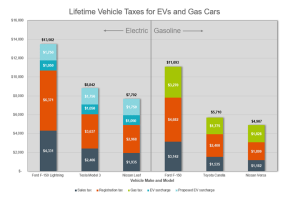
Lifetime cumulative taxes paid by popular year 2025 electric and gasoline cars over a 14-year lifetime.
A $200 annual fee would unfairly penalize EV owners without solving the problem of declining road funding. In fact, according to a recent report from the Minnesota Department of Transportation, increasing the state’s EV fee would provide limited revenue-raising capacity due to currently low levels of adoption.
A proposed $250 federal fee would further burden EV drivers and make it harder to meet state goals
In addition to a much higher state registration surcharge, Minnesota EV drivers are also preparing for the possibility of a new $250 federal EV fee. Federal lawmakers have included the proposal as part of the budget reconciliation bill currently moving through the House of Representatives.
The federal proposal is even more punitive: while EV drivers would be asked to pay $250 annually for federal roadway funding, the average gas car driver pays just $88 per year in federal gasoline taxes. Under this change, Minnesota drivers’ EV fees would increase from $75 per year to $450 almost overnight.
The conversation about a federal EV fee is happening amid an already uncertain electrification landscape. On the first day of his second term, President Donald Trump issued an executive order announcing a decision to eliminate the “electric vehicle mandate” and pause the disbursement of funds for the National Electric Vehicle Infrastructure program. The administration has also announced plans to roll back federal tailpipe emissions standards and eliminate federal EV incentives.
Increasing EV sales is a key part of meeting Minnesota’s transportation decarbonization goals. Despite that, the legislature has not renewed funding for a state EV sales incentive program. Adding a punitive EV tax impacts affordability, hinders sales, and places Minnesota further away from making necessary reductions in transportation emissions.
There’s still time to oppose unfair EV fees!
Drive Electric Minnesota recognizes the need for all Minnesota drivers to contribute to sustainable, ongoing funding to maintain Minnesota’s roads and bridges. However, nearly tripling EV drivers’ registration surcharge, especially given a hostile federal policy landscape, discourages electrification.
Instead of increasing fees on a small group of Minnesota households that already pay their fair share for road funding, the state should consider comprehensive solutions that account for the true causes of declining road funding.
This week, lawmakers are putting their heads together in legislative conference committees to negotiate final language for the bills that will head to the governor’s desk for a signature. Drive Electric Minnesota is advocating for Minnesota EV drivers, but your representatives want to hear from their constituents on this issue.
Speak up: Tell your representatives a $200 EV fee is unfair
Follow these steps to make your voice heard:
- Find out who represents you at the Minnesota Legislature (Minnesota House of Representatives and Minnesota Senate) and click “Contact” to access their contact information.
- Email your legislators, asking them to oppose the EV fee increase.
- Include your address in your email so your legislator knows you are their constituent—legislators prioritize communications from those living in their district!
You can also submit a similar request to Governor Tim Walz through this website.
Sample legislator email:
Dear Representative/Senator (Last Name),
As your constituent, I am writing to urge you to oppose the proposal to increase Minnesota’s electric vehicle (EV) fee to $200.
A $200 annual fee would overburden EV drivers by requiring them to pay more for roadway funding than most gas car drivers. This would discourage progress on electrification and increase barriers to EV ownership for many Minnesota households. It also would not solve the problem of declining road funding, which is caused by inflation and the increasing fuel efficiency of gas vehicles.
Instead of imposing punitive fees on EV drivers, Minnesota lawmakers should consider comprehensive solutions to road funding that address the true causes of declining revenues.
Thank you for your time and consideration.
Sincerely,
(Your name)
(Your address)
Thank you for taking action to oppose unfair taxation on EVs! Electrification is a key component of Minnesota’s strategy to reduce greenhouse gas emissions, improve air quality, increase energy independence, and reduce transportation costs.
Share this post


