
Increase access to charging
Whether you’re looking to provide guidance for others in your community (e.g., employers, property owners, destinations) or install city-supported chargers, we provide the resources you need to get started.
Encourage charger build-out
Providing support to other key decision makers in your community, including multifamily building property owners, employers, and destinations, makes it easier for them to add chargers.
Support can include providing educational resources, providing direction through zoning codes, streamlining permitting EV chargers, and providing financial incentives. Below, we provide a few resources we’ve prepared for these audiences.
Multifamily building property owners
Property owners can learn about the benefits and steps to adding chargers at their properties with our Electric Vehicle-Ready Parking 101 for Multi-Unit Dwelling Property Owners fact sheet.
Employers
Employers can use our Workplace Charging Flowchart and Workplace Charging Checklist to inform their decision-making.
Destinations
Destinations, such as grocery stores, movie theaters, hotels, and more, can use our Public Charging Guidance to inform their decision-making.
Add city-supported chargers
Choosing to install electric vehicle charging demonstrates leadership and a commitment to reducing the largest sector of greenhouse gas emissions in the United States.
Choose the right charger
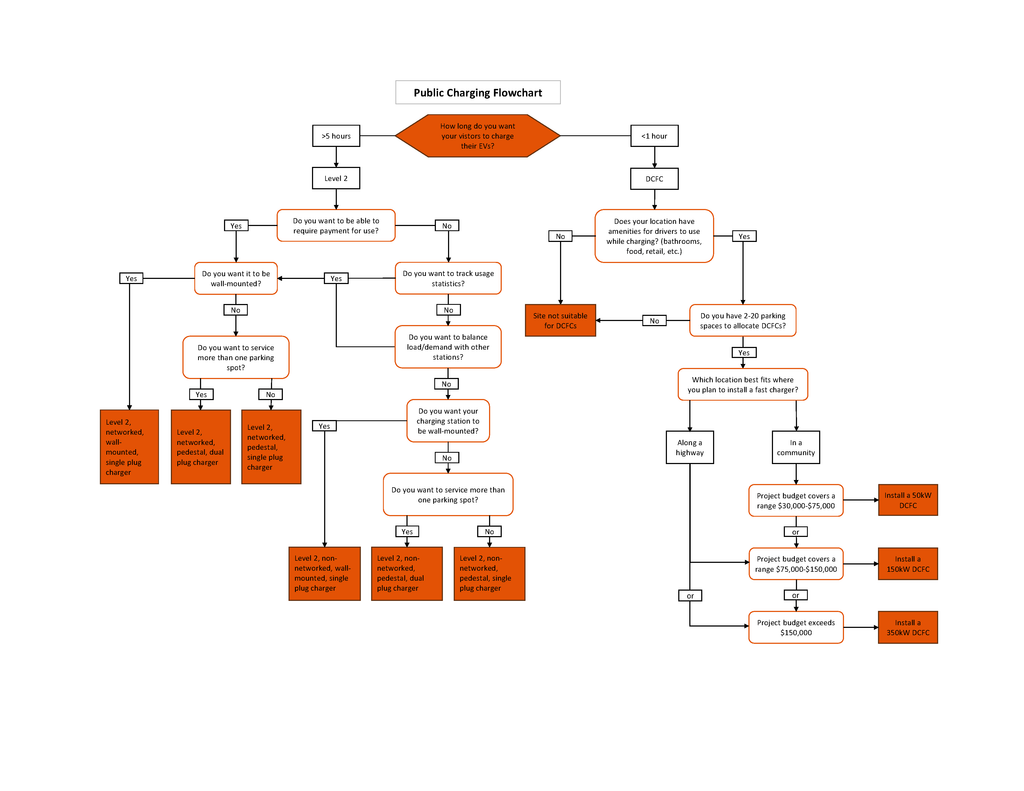
Use our Public Charging Flowchart to navigate key decisions when selecting the right public charger.
Purchase a charger
Purchasing an electric vehicle charging station can be intimidating, given the wide variety of options. Download our guide for information needed to take steps toward purchasing a station, including common station features to consider, where to buy, and funding opportunities.
View Guide to Purchasing an EV Charging Station →
Select a site
Now that you’ve determined what kind of charging station you’re going to get, you need to figure out where you’re going to put it. Use our Site Selection Guidelines to help you determine the best location in your community to install the station.
Install a charger
Looking to install a charging station at a publicly accessible location? Use our Public Charging Checklist below for steps that should be completed once you’ve decided on a location. Click here to download a printable version of the Public Charging Checklist.
Any electrician can install charging stations.
Enphase has a searchable list of electricians they recommend (not limited to Enphase products).
Generally, electric vehicle charging stations only require an electrical permit. In some cases, they may also require a building permit, particularly when structures need to be erected as part of the charging station project (i.e., a carport that provides multiple charging stations).
Work with your contractor to see if your city or county requires anything specific.
The most important factor in reducing installation costs is placing stations as close as possible to the electrical panel that will power them.
For public stations, placing them near the entrance of a parking ramp or near the front of a building helps advertise the station and reaffirms EV owners that you support their choice.
Install stations in a well-lit or visible area to help protect them from vandalism.
Signs help EV drivers find the station on-site and advertise it.
Paint the parking spaces a different color or add a symbol to signal to other drivers that these spaces serve a purpose beyond regular parking.
Proper lighting ensures that EV drivers can see the plug and feel safe using the station in the dark.
Good lighting helps prevent vandalism.
Accidents happen! A small bollard or concrete wheel stop will prevent a minor accident from leading to major repair costs for your charging station.
Every major equipment manufacturer includes a warranty with their product.
Be sure to read the fine print of your warranty; this will save you time and money down the road when potential maintenance of the station is required.
Have a plan in place for when a non-EV parks at the charging station. Installing signage that says “this space is only for electric vehicles while charging” can help eliminate confusion for other drivers. You may want to consider establishing a fine or having vehicles towed that do not abide by the rules you establish.
Tickets can cause resentment toward EV drivers; establish a warning system so that people who may be unaware of having accidentally blocked a charging station are not punished unduly.
Knowing which party is responsible for maintaining the station is essential to keeping it operational. Establish a procedure for what to do if repairs are needed.
Plughare.com is a crowd sourced charging station map. Many EV drivers will use it to find your charging station.
The Alternative Fuels Data Center is maintained by the federal government and will also help users locate your station.
If using a networked station, make sure it is gathering data properly and/or requiring payment properly by utilizing the online tools the manufacturer provides. Contact the manufacturer if you experience any difficulties.
FAQs
Dumb stations behave like a standard outlet and do not offer data tracking, payment collection capabilities, or opportunities to connect to on-site renewable energy or manage charging to reduce electricity costs. Smart charging stations can require payment for use, track charging statistics, and control charging patterns or connections to on-site renewable energy (e.g., time of charging, length of charging, number of unique users, variable pricing), often using cloud network services. While these services have an ongoing subscription cost, they can also enable significant reductions in charging costs for commercial applications compared to an equivalent dumb charger. So, smart chargers are often more expensive to maintain than dumb ones. Additionally, some utility incentive programs require the use of a smart charger so the charging time can be tracked or controlled.
The charger itself can be as little as $400 for a dumb charger (no ability to make users pay for use) or as much as several thousand for a smart charger (credit card swiping, data collection, ability to control charging rates, etc.). Occasionally, utilities will offer a rebate or purchase incentive for a smart Level 2 charging station if you sign up for their time of use or off-peak program. Installation costs can range from $500 to $15,000, depending on the location and the work required to bring electrical service to the charger (e.g., digging up concrete, installing a new panel, installing a new meter, etc.). Home charging installations typically range from $ 500- $2,000, while public installations typically range from $ 5,000- $15,000.
DC fast-charging stations require significant capital investment for purchase and installation. A basic 50kW unit may cost $25,000-$40,000 depending on the manufacturer, and total turnkey installation may cost $60,000-$100,000. Higher power levels, which are better suited to longer-range travel, cost more. For example, 150kW DC fast chargers generally cost $75,000 or more just for the unit. Installation costs, which can be reduced by locating the unit close to an existing transformer, include utility power extensions, three-phase switchgear, parking space paint and signage, associated groundwork, and protective devices such as bollards. Additionally, ongoing software and network, operating, and maintenance costs can be high and should be considered prior to installation.
A 2017 study by the United States Department of Energy, titled “National Plug-In Electric Vehicle Infrastructure Analysis,” recommends 36 publicly available Level 2 charging stations per 1,000 electric vehicles and 1.5 DC Fast Chargers per 1,000 electric vehicles to meet future demand in cities. If your city is near a major highway corridor, providing a fast charger offers major benefits. Anyone who stops to use the charger will spend at least 20 to 30 minutes there, allowing them to engage with surrounding businesses. This brings new customers, increased business traffic, and ample advertising opportunities.
PlugShare has an ever-expanding map of chargers across the country. It has filters to view different types of chargers, plugs, and networks. It also has a mobile app that can be used to locate chargers
For Level 2 chargers, it’s generally preferable to give away electricity instead of charging people. It’s much more expensive to install a smart charger capable of charging user fees than a dumb one without this capability. Installation costs combined with the ongoing operation and maintenance fees of smart chargers generally outweigh the income received through public Level 2 chargers. This is largely because EV owners primarily charge at home. While usage at public Level 2 chargers is lower than home chargers, they nevertheless play a crucial role in increasing EV adoption.
For DC fast chargers, it’s preferred to charge user fees due to the expensive installation cost. Installing a fast charger generally costs around $60,000 for a 50kW station, and there are ongoing operating and maintenance expenses to consider.