
Select a charger
It couldn’t be simpler to charge your electric vehicle—we’ll help you break it down!
Level 1 charging
Charging a vehicle at “Level 1” means plugging into a standard 120-volt outlet (a typical household electrical outlet). It requires no extra equipment or installation. On average, Level 1 charging provides 2 to 5 miles of vehicle range per hour the vehicle is connected.
Level 2 charging (J1772)
Charging a vehicle at “Level 2” means plugging into a 240-volt outlet (the same kind that powers large appliances like clothes dryers). Adding a 240-volt dedicated circuit requires an electrical permit, which licensed electricians can pull. Installing a Level 2 charger requires a licensed electrician. On average, Level 2 stations provide PHEVs with 6-32 miles of range per hour and BEVs with 16-69 miles of range per hour the vehicle is connected.
Save money through electric utility programs
Electric utilities, from local municipal to investor-owned utilities, are essential in accelerating EV adoption.
If not carefully planned, more EVs charging on the electric grid can require distribution system upgrades. Utilities plan for increased electricity load by encouraging consumers to charge during low-demand times like overnight (i.e., off-peak) through specialized rates and smart charging technology, generally making it cheaper for EV drivers to charge their vehicles. Thoughtfully integrating EVs into the electric system can even drive electricity rates for all utility customers down, including those who don’t drive an EV.
Find a program near you
To find information about electric utility programs that can lower your charging costs, visit MNCharging.org and select your utility. If you can’t find any information online, give them a call!
Find other ways to save money on charging by visiting ElectricForAll.
Charge your EV with renewable energy
Many utilities also offer renewable energy programs, allowing EV drivers to further reduce their carbon footprint. The list below provides links to some of the larger programs available in Minnesota.
Xcel Energy
Renewable*Connect®
Solar*Rewards®
Solar*Rewards Community®
Minnesota Power
Community Solar Garden
SolarSense
Beyond utility programs, EV drivers can also power their vehicles directly with on-site renewable energy, making trips emission-free and creating additional cost savings and benefits.
Solar energy is the most common on-site option for linking renewable energy to EV charging. Doing so can maximize the value of the on-site solar production and reduce the grid impacts of EV charging. This option works best if the EV is being charged during the middle of the day, when solar energy is available, such as when vehicles are parked at home or at workplaces, parking ramps, retail centers, and public amenities like parks. However, technology to link and manage on-site solar production with EV charging is still nascent, so it may not be available for all charging types or utility service areas.
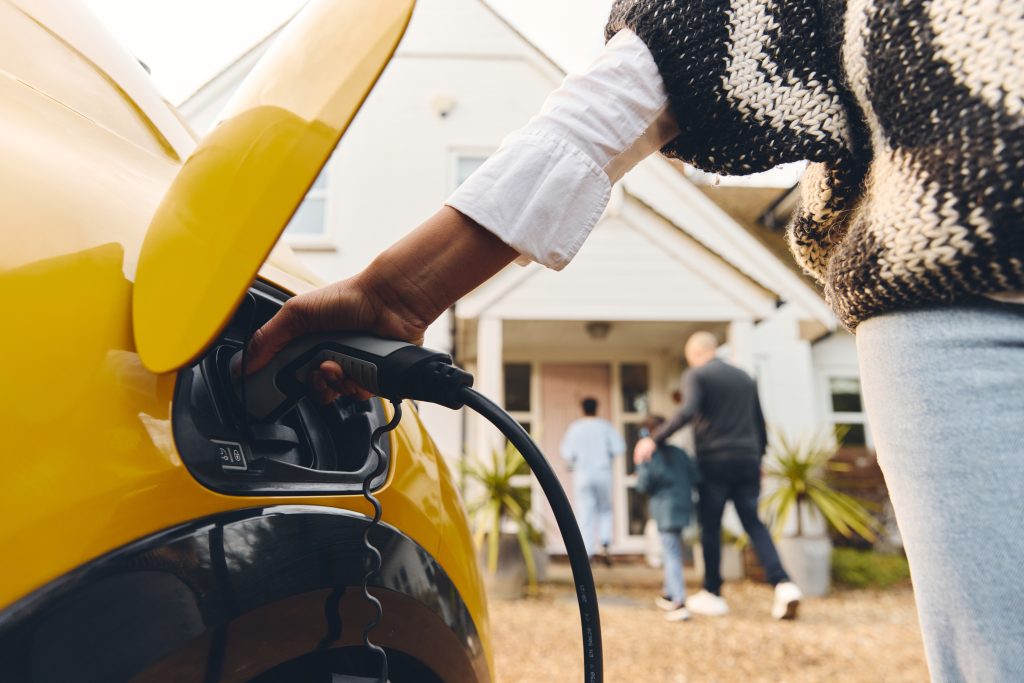
Most EV owners have a charging station or outlet in their garage and charge their EV each night, waking up with a full battery. There are a few different kinds of chargers with various voltages that charge the battery at different speeds. Depending on the size of your battery and how far you typically drive in a day, you might simply need to plug the cord that comes with your vehicle into a standard wall outlet. Read more about Level 1 vs. Level 2 charging above.
Installing a Level 2 charger is a relatively simple process, much like installing the wiring for a clothes dryer or other heavy appliance. Electricians can usually install this in a few hours, and your electric utility can connect you to an experienced installer. Installation costs can vary for this service and tend to be around $500-2,000.
All electricians have the basic skill set needed to install home charging infrastructure. If needed, your utility should be able to provide the names of electrical companies that have provided this service in your area. For example, Xcel Energy has a list of EV Charging Station Installers.
It’s important to check with your landlord or housing manager before purchasing an EV, as your ability to charge at your home depends on their willingness to install a charger for you. If home charging is not an option, you may be able to charge at work. Public charging is also available, though it is more expensive than home charging. For more information about installing charging in a multi-unit dwelling, check out mudcharging.com.
It depends on the type of charger and the remaining state of charge. Level 1 charging provides 2-5 miles of vehicle range per hour, Level 2 provides PHEVs with 6-32 miles and BEVs with 16-69 miles of vehicle range per hour, and DC fast chargers provide BEVs with 136-1,045 miles of range per hour.
Forgetting to plug in your EV at night is usually not a big deal, since most people use less than half of their range in a day. If you do forget to plug in and need to go beyond your current range, you will need to stop at a public charging station, just as you would at a gas station if you ran out of gas. You can locate charging stations at https://www.plugshare.com/ or https://www.afdc.energy.gov/stations/#/find/nearest.
EVSE, or electric vehicle supply equipment, is another name for the components that make up a charging station.
A time of use rate, or TOU, is a rate offered by utilities to incentivize consumers to use electricity during specific times, generally times of low electricity demand. Typically, customers pay a higher rate when electricity demand is higher, so the time you use electricity is just as important as how much you use. TOU rates offer significant benefit to EV drivers, as most EV charging is done overnight during the low-demand, low-rate time.